

Search

Key: test item, instrument name, total nonvolatile migration, gravimeter, moisture permeameter
The determination of "constant weight" in pharmaceutical manufacturing
Release time:
2025-12-15
The determination of "constant weight" in pharmaceutical manufacturing
It is a critical quality control procedure in pharmaceutical manufacturing. The determination of "constant weight" is a fundamental concept in gravimetric analysis, which is the basis for ash content testing.
In the pharmaceutical industry, the standards and testing methods for ash content (and thus the concept of constant weight) are primarily governed by major Pharmacopeias.
Here is a summary of the standards and testing method, particularly focusing on the "constant weight" requirement, using terminology from the United States Pharmacopeia (USP) and relevant common practices.
Ash Determination Standards (Pharmacopeias)
The global standards for pharmaceutical testing, including ash content, are primarily established by the following major pharmacopeias:
| Standard/Compendium | Relevant General Chapters | Key Term |
|---|---|---|
| United States Pharmacopeia (USP) | General Chapters such as(731)Loss on Drying and (281)Residue on Ignition (or Sulfated Ash) | Ignite to Constant Weight |
| European Pharmacopoeia (Ph. Eur.) | General Chapter 2.4.14 Sulphated Ash (Similar concept for Total Ash/Residue on Ignition) | Ignited to Constant Mass |
| Japanese Pharmacopoeia (JP) | Similar general tests for Residue on Ignition or Ash Content | Constant Mass |
| Chinese Pharmacopoeia (Ch.P.) | General Chapters for Total Ash and Acid-Insoluble Ash (As discussed previously) | 恒重 (Constant Weight) |
1. Definition of "Ignite to Constant Weight" (USP Standard)
The most precise definition for "constant weight" is found in the USP General Notices and Requirements. The definition ensures the complete removal of all volatile materials and the complete combustion of organic matter.
"Ignite to constant weight" means that ignition shall be continued at 800°C±25°C (unless otherwise indicated) until two consecutive weighings, the second of which is taken after an additional period appropriate to the nature and quantity of the residue, do not differ by more than 0.5mg per gram of substance taken (or other limit specified in the monograph).
Note: For the crucible preparation step, the typical requirement for two consecutive weighings is often ≤0.3mg (or 0.0003g). Always check the specific monograph or General Chapter.
Testing Method: Total Ash / Residue on Ignition
The following outlines the general testing procedure for achieving constant weight in the gravimetric determination of ash (often called Total Ash or Residue on Ignition):
1. Preparation of the Crucible
The crucible must be pre-treated to ensure its weight will not change during the sample analysis, effectively making it a tare weight.
- Place a clean crucible (porcelain, platinum, or silica) in a muffle furnace and ignite it at the required temperature (e.g., 600°C or 800°C) for 30 minutes.
- Transfer the crucible to a desiccator (containing a suitable desiccant like silica gel) and allow it to cool to room temperature.
- Weigh the cooled crucible accurately.
- Repeat the ignition, cooling, and weighing steps until the difference between two successive weighings is ≤0.3mg. This is the constant weight of the empty crucible (W0).
2. Sample Preparation and Initial Ashing
- Accurately weigh the specified amount of sample (typically 1 to 2 grams) into the pre-weighed, constant-weight crucible (Wsample).
- Gently char the substance by heating over a low flame or on a hot plate, ensuring no ash is lost due to spattering or rapid combustion.
- Transfer the crucible to the muffle furnace and ignite at the specified temperature (e.g., 500°C to 600°C for Total Ash, or 800°C for Residue on Ignition/Sulfated Ash). The ignition is continued until the carbon is consumed and a gray or white residue remains.
3. Achieving Constant Weight of the Ash Residue
This is the critical step for ensuring the result's validity.
- After the initial incineration period (e.g., 2–4 hours), remove the crucible from the furnace.
- Transfer it to the desiccator and allow it to cool completely.
- Weigh the crucible and the residue (W1).
- Return the crucible to the muffle furnace for an additional ignition period (e.g., 30 to 60 minutes).
- Cool in the desiccator and weigh again (W2).
- Check the Difference: The process is repeated until the difference between the consecutive weighings (|W1-W2|) is within the accepted limit (e.g.,≤0.50mg or other specified limit). The final weight is the constant weight of the crucible and ash (Wfinal).
4. Calculation
The percentage of ash content is calculated as follows:

Key Terminology
| English Term | Definition/Context |
|---|---|
| Constant Weight | The state where repeated heating/ignition, cooling, and weighing yield a difference between two consecutive weighings that is within the specified tolerance (e.g., ≤0.3mg). |
| Residue on Ignition (ROI) / Sulfated Ash | A standardized test used primarily for synthetic organic substances in pharmaceuticals. It involves adding sulfuric acid to aid in combustion and is typically ignited at 600°C or 800°C |
| Total Ash | Used primarily for herbal drugs (Crude Drugs), representing the total inorganic matter remaining after combustion. |
| Muffle Furnace | The high-temperature oven used to ignite the sample. |
| Crucible | The heat-resistant vessel (e.g., made of porcelain, silica, or platinum) used to hold the sample. |
| Desiccator | An enclosed container used to cool the hot crucible in a moisture-free environment to prevent the residue from re-absorbing water before weighing. |
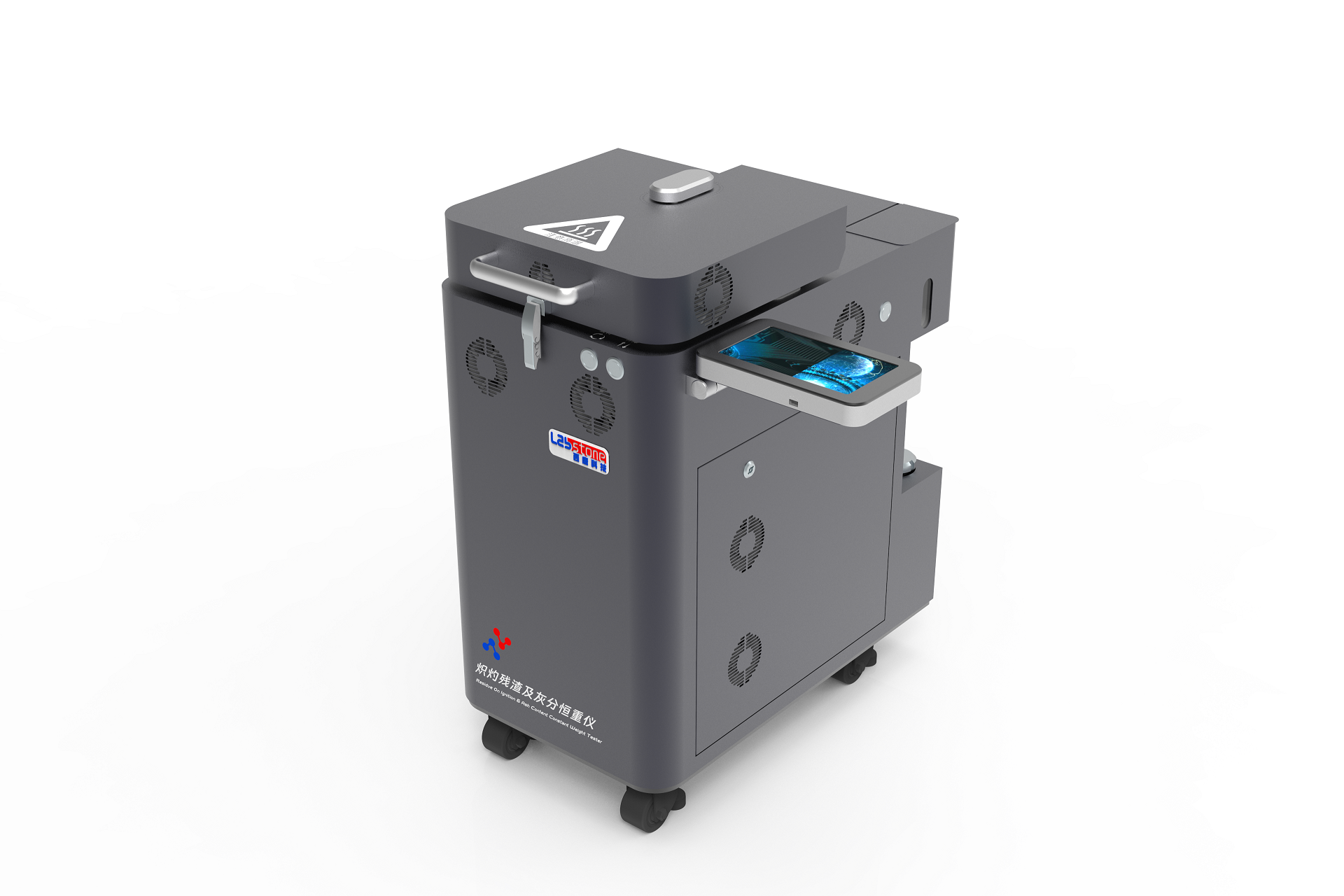
LabStone has developed and manufactured a highly integrated, automated test instrument for constant weight determination based on the standards described above. This system integrates a muffle furnace, a desiccator, a cooling chamber, and a weighing unit (balance) into a single test chamber. Throughout the entire process, the operator only needs to place the crucibles and the test samples into the chamber. The equipment will then automatically complete the constant weight determination according to the pre-set workflow.
Click the following picture to learn more about the Constant Weight Determination of Total Ash/Residue on Ignition or Sulfated Ash Tester.
Related News
2026-06-01
The Total Migration and Non-Volatile Residue Constant Weight Tester is a laboratory instrument designed for precise gravimetric analysis of residues in packaging materials, food contact materials, pharmaceuticals, and chemical products.
ASTM F1249 Explained: Water Vapor Transmission Rate (WVTR) Testing Standard
2026-06-01
Water Vapor Transmission Rate (WVTR) Testing Standard

Why Residue After Evaporation Testing Is Becoming More Important in Pharmaceutical QC Laboratories
2026-05-18
Residue After Evaporation Testing Is Becoming More Important in Pharmaceutical QC Laboratories
Contact Us
Guangzhou Labstone Technology Co., Ltd
Add: Rm601, bldg A1, No. 2-6, Jinbao Rd, Baiyunhu Subdist., Baiyun District, Guangzhou,510430, Guangdong Province, P.R.China
Switchboard:+86(20)86406230 Technical:+86(20)86406337
WhatsApp & Wechat:+86-13825027743
Email:market@labstone.cn
Leave a Message to us
fOLLOW